<?xml version="1.0" encoding="UTF-8"?>
<?xml-stylesheet type="text/xsl" href="/wp-content/themes/feed/atom.xsl"?>
<feed
        xmlns="http://www.w3.org/2005/Atom"
        xmlns:wwe="http://release.wwe.com/atom/1.0"
        xmlns:thr="http://purl.org/syndication/thread/1.0"
        xmlns:taxo="http://purl.org/rss/1.0/modules/taxonomy/"
        xml:lang="en-US"
        xml:base="https://www.susaneisenberglaw.com/wp-atom.php"
	>
    <title type="text">Susan Levy Eisenberg, P.C.</title>
    <subtitle type="text">Susan Levy Eisenberg, P.C.</subtitle>

    <updated>2026-04-16T08:58:29Z</updated>

    <link rel="alternate" type="text/html" href="https://www.susaneisenberglaw.com" />
    <id>https://www.susaneisenberglaw.com/feed/atom/</id>
    <link rel="self" type="application/atom+xml" href="https://www.susaneisenberglaw.com/feed/atom/?forceByPassCache=0.6549488476991139" />
	
	<generator uri="https://wordpress.org/" version="6.9.4">WordPress</generator>
<icon>/wp-content/uploads/sites/1603815/2021/06/cropped-Susan-Site-Icon-min-32x32.jpg</icon>
        <entry>
            <author>
									                    <name>On Behalf of Susan Levy Eisenberg, P.C.</name>
				            </author>
            <title type="html"><![CDATA[A new year brings updated child support guidelines]]></title>
            <link rel="alternate" type="text/html" href="https://www.susaneisenberglaw.com/blog/2022/01/a-new-year-brings-updated-child-support-guidelines/" />
            <id>https://www.susaneisenberglaw.com/?p=46868</id>
            <updated>2023-04-06T11:47:37Z</updated>
            <published>2022-01-11T16:09:59Z</published>
					<taxo:topics><![CDATA[-]]></taxo:topics>
            <summary type="html"><![CDATA[With the new year comes significant changes for parents in Pennsylvania who pay and receive financial support.  The support guidelines are regularly updated but have not been for approximately four years until now. The new policies went into effect on January 1, 2022.  However, Courts will not automatically grant more child support despite the guidelines being updated. Instead, parents will…]]></summary>
			                <content type="html" xml:base="https://www.susaneisenberglaw.com/blog/2022/01/a-new-year-brings-updated-child-support-guidelines/"><![CDATA[With the new year comes significant changes for parents in Pennsylvania who pay and receive financial support.  The support guidelines are regularly updated but have not been for approximately four years until now.

<a href="https://casetext.com/case/in-re-order-amending-rules-191031" data-wpel-link="external" target="_blank" rel="noopener noreferrer">The new policies</a> went into effect on January 1, 2022.  However, Courts will not automatically grant more child support despite the guidelines being updated. Instead, parents will have to file modification requests to secure new orders from the Court.

<strong>Modest increases</strong>

While the increases are modest, they are all different and based upon the parties’ different income levels.  Parents could see the following changes depending on the parties’ combined net monthly incomes as follows:
<ul>
 	<li><strong>$4,000 to $10,000</strong> – 10 percent increase for one child and less than a 15 percent change for multiple children.</li>
 	<li><strong>$10,000 to $15,000</strong> – 15 percent increase for one child and 23 percent for more than one child.</li>
 	<li><strong>$20,300 to 22,600</strong> – 22 percent increase for one child and 24 percent for multiple children.</li>
 	<li><strong>$30,000+</strong> – More than a 25 percent increase for one child and significantly reduced amounts for more than one child.</li>
</ul>
The chart stops where the combined monthly net income exceeds $30,000 due to the lack of reliable economic data regarding the reasonable needs of children. Those families who have a <u>combined</u> monthly net income in excess of $30,000 per month are considered high-income cases and a three step process is used to calculate child support.  Having an experienced family law attorney will help you navigate this process and allow you to obtain the results based on your particular situation.

Parents who file for modifications must show grounds.  This means your filing must show a basis for your request and the change in the guidelines is considered sufficient grounds for a modification.  The court may also consider income decreases or increases, the amount of insurance premiums, childcare expenses, and extracurricular activity costs.  If any of these circumstances exist now, they may also justify a modification of child support.  It is extremely important that you file as soon as possible as any modification can only be granted as of the date the request is filed with the court.

Ever-changing family laws in support, custody and divorce require the skills of an experienced attorney who possesses both the knowledge and expertise regarding newly developing regulations and procedures.  If you would like assistance regarding a child support modification, please contact my office at [nap_phone id="LOCAL-CT-NUMBER-1"] or email <a href="mailto:eisenberglaw@comcast.net">eisenberglaw@comcast.net</a> in order to discuss your specific case.]]></content>
						        </entry>
	        <entry>
            <author>
									                    <name>On Behalf of Susan Levy Eisenberg, P.C.</name>
				            </author>
            <title type="html"><![CDATA[Prepping for property  division helps streamline your divorce]]></title>
            <link rel="alternate" type="text/html" href="https://www.susaneisenberglaw.com/blog/2021/10/prepping-for-property-division-helps-streamline-your-divorce/" />
            <id>https://www.susaneisenberglaw.com/?p=46845</id>
            <updated>2023-04-06T11:47:40Z</updated>
            <published>2021-10-06T17:31:10Z</published>
					<taxo:topics><![CDATA[-]]></taxo:topics>
            <summary type="html"><![CDATA[There is no question that you want your divorce to unfold as smoothly as possible. That said, you probably do not look forward to the property division phase of the proceedings. Organizing your finances will help you streamline the process and enter the future with greater confidence. Gathering information Track your expenses: household bills, mortgage payments, food, transportation, clothing and…]]></summary>
			                <content type="html" xml:base="https://www.susaneisenberglaw.com/blog/2021/10/prepping-for-property-division-helps-streamline-your-divorce/"><![CDATA[There is no question that you want your divorce to unfold as smoothly as possible.

That said, you probably do not look forward to the property division phase of the proceedings. Organizing your finances will help you streamline the process and enter the future with greater confidence.
<h2>Gathering information</h2>
Track your expenses: household bills, mortgage payments, food, transportation, clothing and anything else you spend money on. Add your bank and credit card statements, investment and <a href="/family-law/property-division/" target="_blank" rel="noopener" data-wpel-link="internal">retirement account</a> statements, pay stubs and tax return copies. Keep in mind that the amount of money coming in is about to change since one income source will disappear once the divorce is final. The information you put together will help a judge determine whether to award spousal support. Admittedly, gathering your financial information takes time but the results will be rewarding. Not only will having comprehensive information help smooth the way through the property division process and the court’s determinations, but it will also assist you in planning for life after divorce.
<h2>Avoiding large expenditures</h2>
Unless your divorce attorney sees a potential problem, such as an acrimonious relationship between you and your spouse, you can continue to use your joint and separate accounts as usual. However, with the divorce pending, be sensible with spending and avoid making large purchases.
<h2>Looking ahead</h2>
Pennsylvania is a no-fault state. So, regardless of the reason for the break-up of your marriage, you want the divorce process to go as smoothly as possible, especially property division. Preparation is key. The more organized you are, the better chance you have of navigating this event successfully and entering the post-divorce world with greater confidence.]]></content>
						        </entry>
	        <entry>
            <author>
									                    <name>On Behalf of Susan Levy Eisenberg, P.C.</name>
				            </author>
            <title type="html"><![CDATA[PPP funding and the impact on child support]]></title>
            <link rel="alternate" type="text/html" href="https://www.susaneisenberglaw.com/blog/2021/07/ppp-funding-and-the-impact-on-child-support/" />
            <id>https://www.susaneisenberglaw.com/?p=46684</id>
            <updated>2023-04-06T11:47:44Z</updated>
            <published>2021-07-30T14:45:46Z</published>
					<taxo:topics><![CDATA[-]]></taxo:topics>
            <summary type="html"><![CDATA[When pandemic-related shutdowns began, business owners who relied on a steady stream of paying customers every day were suddenly forced to bar them from entering their premises. They had no choice but to explore options to continue bringing in money, with many incorporating delivery or curbside services. However, revenues continued to lag as people decided to stay home. Some businesses…]]></summary>
			                <content type="html" xml:base="https://www.susaneisenberglaw.com/blog/2021/07/ppp-funding-and-the-impact-on-child-support/"><![CDATA[When pandemic-related shutdowns began, business owners who relied on a steady stream of paying customers every day were suddenly forced to bar them from entering their premises. They had no choice but to explore options to continue bringing in money, with many incorporating delivery or curbside services.

However, revenues continued to lag as people decided to stay home. Some businesses closed with countless employees let go simply because owners could not afford to pay them.
<h2>The Paycheck Protection Program to the rescue</h2>
In response to the significant downturn businesses experienced, the Paycheck Protection Program (PPP) was launched to help hard-working entrepreneurs continue their operations with loans used to pay staff during the shutdowns.

As with any new government program, complexities exist in the processing and dispersing of financial support. Issues become more challenging if the money goes to a business owner who pays <a href="https://www.sequenceinc.com/fraudfiles/2020/04/paycheck-protection-program-ppp-loans-and-child-support-covid-19/" target="_blank" rel="noopener noreferrer" data-wpel-link="external">child support</a> as part of a divorce agreement.

Two sources of income, specifically paychecks and net profits, are factors in the child support calculator. Loans are not considered income because they are not revenue from selling products. PPP financing is specifically used to pay employees, including the person who owns and operates the business.

Some business owners use PPP to pay their employees and not themselves. However, what may seem like a sacrifice to ensure employees can make ends meet could raise red flags with accusations of manipulating the system, particularly those who pay child support. Information on the loan application could reveal this form of “shell game” should the owner’s salary be missing from the document.

Most businesses have yet to see net profits return to normal, even with financial help. A large portion of PPP money provided is likely to be forgiven, with the remaining considered income for the business owner. The custodial spouse should take the time to ensure that the remainder is in the net profit category for support purposes.

Most who run their own businesses and using PPC money for its exact purpose (paying employees) are not enriching themselves. That doesn’t mean that the incoming funds should be ignored when it comes to child support calculations. Full disclosure will paint a clear picture and ensure that children receive the financial support they need during life-changing times.]]></content>
						        </entry>
	        <entry>
            <author>
									                    <name>On Behalf of Susan Levy Eisenberg, P.C.</name>
				            </author>
            <title type="html"><![CDATA[Post-Pandemic Prenuptial Agreements]]></title>
            <link rel="alternate" type="text/html" href="https://www.susaneisenberglaw.com/blog/2021/06/post-pandemic-prenuptial-agreements/" />
            <id>https://www.susaneisenberglaw.com/?p=46354</id>
            <updated>2023-04-06T11:47:48Z</updated>
            <published>2021-06-04T22:17:39Z</published>
					<taxo:topics><![CDATA[-]]></taxo:topics>
            <summary type="html"><![CDATA[Post-Pandemic Prenuptial Agreements COVID-19 has had an impact on how couples and families manage their financial lives. The pandemic has made many people realize the importance of having their affairs in order, especially in the event of a crisis such as illness or job loss. Just as emergency funds are the foundation of strong personal money management, having a prenuptial agreement (or…]]></summary>
			                <content type="html" xml:base="https://www.susaneisenberglaw.com/blog/2021/06/post-pandemic-prenuptial-agreements/"><![CDATA[<img src="/wp-content/uploads/sites/1603815/2021/06/shutterstock-300x200.jpg" alt="" width="300" height="200" />
<div></div>
<img src="/wp-content/uploads/sites/1603815/2021/06/Eisenberg-Susan-240x300.jpg" />
<div>

<strong>Post-Pandemic Prenuptial Agreements </strong>

COVID-19 has had an impact on how couples and families manage their financial lives. The pandemic has made many people realize the importance of having their affairs in order, especially in the event of a crisis such as illness or job loss.

Just as emergency funds are the foundation of strong personal money management, having a prenuptial agreement (or postnuptial agreement) in place is also crucial for crisis planning. While prenuptial agreements are often thought of as a safety net for an equitable division of assets in the event of a divorce, these agreements are also very helpful when one spouse dies.

A prenup or postnup can determine how your marital assets will be handled among surviving family members. These agreements can establish expectations in order to reduce potential, future conflict among the surviving spouse, children from the marriage and/or children from any previous marriages. It clarifies property and debt division in the event of a spouse’s death so as to avoid any confusion during an otherwise difficult time.

The term “<strong>premarital agreement</strong>” means an agreement between prospective spouses made in contemplation of marriage and to be effective upon marriage. Regarding the death of a spouse, prenuptial agreements may address these matters:
<ul>
 	<li>Property and debt division</li>
 	<li>Matters related to a family business</li>
 	<li>Rights to inheritance or gifts acquired by the other spouse</li>
 	<li>Claims for death benefits from the other spouse’s insurance</li>
</ul>
I have found in my years of practice that there are generally three categories in which individuals contact me with respect to these agreements and what these agreements can include:
<ul>
 	<li>They want to protect very specific assets or a business that existed before the marriage and prevent these assets from being inherited by a spouse;</li>
 	<li>They want to prevent their premarital assets from being divided in the event of divorce; and,</li>
 	<li>They want to spell out specifically how their assets would be divided in the scenario of divorce. This type of inquiry is often made by individuals who have already been through a divorce and failed to consider entering into a pre-nup agreement.</li>
</ul>
In addition, there are some common misconceptions about prenuptial agreements which is why it is very important that an experienced family law attorney is involved in the preparation and drafting of a pre-nuptial agreement.
<ul>
 	<li>Individuals are under the impression that a prenup must be done within a certain time period before the marriage takes place. In actuality, there is no specific time frame – it can even be signed on the day of the marriage. In fact, the agreement can also be drafted and signed after the marriage which would then be considered a post-nuptial agreement.</li>
 	<li>People are often under the mistaken impression that these agreements are truly valid contracts and can be broken or simply not followed.  In fact, pre/post nuptial agreements are binding in the state of Pennsylvania <u>if</u> there is a full and fair disclosure of assets and debt from both parties at the time of signing.  This is an essential term of these agreements and one spouse could challenge the validity of the agreement if they can show that certain assets were not disclosed.  This is yet another reason why an experienced attorney should prepare these agreements.</li>
</ul>
With experience and proper advice, prenuptial agreements can be a useful and beneficial tool to avoid unnecessary conflict and stress later on and give individuals peace of mind regarding assets that they wish to protect.

If you are interested in drafting a prenuptial agreement to protect your assets and income and avoid the potential pitfalls of a divorce action, contact us to get started. We have drafted many types of agreements, ranging from simple agreements that exclude premarital assets to those that help parties avoid divorce litigation Call <a href="tel:+1-215-860-9700" data-wpel-link="internal">215-860-9700</a> or contact us :<a href="/contact/" data-wpel-link="internal">https://susaneisenberglaw.com/contact-2/
</a>

</div>]]></content>
						        </entry>
	        <entry>
            <author>
									                    <name>On Behalf of Susan Levy Eisenberg, P.C.</name>
				            </author>
            <title type="html"><![CDATA[Money and Divorce: How to Handle Joint Bank Accounts, Credit Cards, Health Insurance]]></title>
            <link rel="alternate" type="text/html" href="https://www.susaneisenberglaw.com/blog/2021/05/money-divorce-how-to-handle-joint-bank-accounts-credit-cards-health-insurance/" />
            <id>https://www.susaneisenberglaw.com/?p=46362</id>
            <updated>2023-04-06T11:47:51Z</updated>
            <published>2021-05-24T22:59:22Z</published>
					<taxo:topics><![CDATA[-]]></taxo:topics>
            <summary type="html"><![CDATA[How much does divorce cost? The cost of getting a divorce depends on many components, and there’s no definitive answer at the beginning of the process. A determining factor is whether the divorce is contentious or not. The more contentious the divorce, the more time it can take to come to agreement over issues. Contested issues are often alimony, child…]]></summary>
			                <content type="html" xml:base="https://www.susaneisenberglaw.com/blog/2021/05/money-divorce-how-to-handle-joint-bank-accounts-credit-cards-health-insurance/"><![CDATA[<img class="alignnone size-medium wp-image-46375" src="/wp-content/uploads/sites/1603815/2021/06/shutterstock1-300x200.jpg" alt="" width="500" height="300" />

<img class="alignnone size-medium wp-image-46358" src="/wp-content/uploads/sites/1603815/2021/06/Eisenberg-Susan-1-240x300.jpg" alt="" width="240" height="300" />

<ol>
 	<li><strong>How much does divorce cost?</strong></li>
</ol>
The cost of getting a divorce depends on many components, and there’s no definitive answer at the beginning of the process. A determining factor is whether the divorce is contentious or not. The more contentious the divorce, the more time it can take to come to agreement over issues. Contested issues are often alimony, child custody and support, and division of marital property and debt. The cost of divorce includes attorney’s fees, filing fees, and experts such as child custody evaluators and financial analysts. Each party in the divorce typically hires their own lawyer to help them through the process and look out for their best interests. Your lawyer will have to spend time collecting financial documents and other legal information, negotiate a settlement agreement, and possibly prepare motions and represent you in hearings and a divorce trial. Lawyers typically charge by the hour.
<ol start="2">
 	<li><strong>How should we handle our joint bank accounts? </strong></li>
</ol>
Joint bank account holders share equal ownership of the account. The contents are considered marital property, and usually would be distributed equitably in the divorce settlement. Because either owner can deposit or withdrawal money without the other’s permission, it’s always best to confer with your lawyer to come up with a plan about how to handle joint accounts, and what actions to take.  You’ll want to segregate joint accounts, split them in an equitable manner, and keep everything separate from the point you separate going forward. The most ideal scenario would be to close the account together, split the funds, and open new accounts in your own names. If you’ve got an uncooperative spouse, however, contact your lawyer for next steps. You may also ask your lawyer to contact the bank to request that the account be frozen until the courts are involved. It would ensure that neither spouse is liquidating the marital estate, and that everything is safely protected until the divorce is final. This may require a court order, as well.
<ol start="3">
 	<li><strong>How do we handle credit card debt?</strong></li>
</ol>
Both parties are responsible for debt accrued during the marriage, regardless of who incurred it.  If you have joint credit cards, it’s best pay off any balances and cancel them, or transfer them into one spouse’s name, if possible. If you can’t pay off the balance right away, it’s a good idea to notify the credit card company, in writing, of the pending divorce, and request that once you’ve paid off the balance, the account be closed. If you don’t take action on your joint credit cards, you’ll still share the responsibility for any new debt your ex-partner may accrue with the credit card company, even if this debt is not considered “marital.” This could also negatively affect your credit score – if you incur more debt, it can lower credit scores. This is true for mortgages and lines of credit, as well. Make sure to establish a credit card solely in your name, especially for emergencies and for establishing credit on your own. Remove your spouse as an authorized user on any of your cards, if possible.
<ol start="4">
 	<li><strong>Will I lose my health insurance/benefits right away?</strong></li>
</ol>
If one spouse is carrying the health insurance for another, it’s illegal for that spouse to drop the other, or the children, during the separation or divorce proceedings. The PA Support Code and the Divorce Code protect the non-insurance carrying spouse from this action. If this happens, the spouse’s employer must restore the coverage when they are made aware of the error, if a court so orders. If you have been dropped from your spouse’s health insurance coverage, it is important to seek the help of lawyer immediately to correct the situation and make sure you are covered. Once the divorce is final, the dependent spouse will be removed from the health insurance policy provided by the spouse’s employer, and usually qualifies for a Special Enrollment Period (SEP) for health benefits, which lasts for 60 days, due to life event changes. Divorce is considered a qualifying life event. During this time the individual can enroll in whatever health insurance option makes the most sense. Options for health insurance after divorce include obtaining your own policy or possibly continuing your current health insurance through COBRA – the Consolidated Omnibus Budget Reconciliation Act – if it applies to the ex-spouse’s employer. COBRA generally applies to all private-sector group health plans maintained by employers that had at least 20 employees on more than 50 percent of its typical business days in the previous calendar year. It also applies to plans sponsored by state and local governments. COBRA allows eligible individuals to extend coverage temporarily under their ex-spouse’s employer’s plan, at their own expense, for up to 36 months (sometimes 18). COBRA is known to be expensive, however, and there may be more cost-efficient alternatives. One of those is to explore healthcare plans offered by your current employer, or you can also shop for various plans on your state exchange, the federal marketplace, or in the private marketplace.

If you are considering filing for divorce in Pennsylvania, give the team at Susan Levy Eisenberg, Attorney at Law a call today. As one of Bucks County’s and Montgomery County’s premier Matrimonial Law attorneys, Susan and her team have served the area with three decades of distinguished divorce negotiation and representation.

<!-- post content -->]]></content>
						        </entry>
	        <entry>
            <author>
									                    <name>On Behalf of Susan Levy Eisenberg, P.C.</name>
				            </author>
            <title type="html"><![CDATA[Child Custody 101 – Some Key Factors in Determining Custody in Pennsylvania]]></title>
            <link rel="alternate" type="text/html" href="https://www.susaneisenberglaw.com/blog/2021/04/child-custody-101-some-key-factors-in-determining-custody-in-pennsylvania/" />
            <id>https://www.susaneisenberglaw.com/?p=46363</id>
            <updated>2023-04-06T11:47:55Z</updated>
            <published>2021-04-23T22:59:29Z</published>
					<taxo:topics><![CDATA[-]]></taxo:topics>
            <summary type="html"><![CDATA[Child Custody 101 – Some Key Factors in Determining Custody in Pennsylvania By Susan Levy Eisenberg If you’re considering divorce, one of the most daunting and scary anticipated changes can be child custody – how often you will see your children and what role you will play in their lives as a major decision maker. The process of determining child…]]></summary>
			                <content type="html" xml:base="https://www.susaneisenberglaw.com/blog/2021/04/child-custody-101-some-key-factors-in-determining-custody-in-pennsylvania/"><![CDATA[<img class="alignnone size-medium wp-image-46379" src="/wp-content/uploads/sites/1603815/2021/06/shutterstock2-300x200.jpg" alt="" width="300" height="200" />
<img class="alignnone size-medium wp-image-46358" src="/wp-content/uploads/sites/1603815/2021/06/Eisenberg-Susan-1-240x300.jpg" alt="" width="240" height="300" />

Child Custody 101 – Some Key Factors in Determining Custody in Pennsylvania By Susan Levy Eisenberg If you’re considering divorce, one of the most daunting and scary anticipated changes can be child custody – how often you will see your children and what role you will play in their lives as a major decision maker. The process of determining child custody may feel uncertain and confusing, but working with a reputable family lawyer to walk you through it is key.

<strong>The two types of custody: legal and physical </strong> In Pennsylvania, there are two basic types of custody: <strong>legal custody</strong> and <strong>physical custody. </strong>
<ul>
 	<li><strong>Legal custody</strong> refers to the parental rights to make important decisions relating to health, education and welfare.</li>
 	<li><strong>Physical custody</strong> is the determination of whom the child lives with and the right to care for the child’s everyday needs.</li>
</ul>
Legal custody is usually shared between the two parents. Physical custody depends on the specific circumstances of each case and is based on the “best interests” of the children.  There are certain circumstances, and these are very fact specific, where one party can have more custodial time or even supervised custodial time.

<strong>Who determines child custody? </strong> The best scenario for the children are when parents work with their lawyers outside of the courtroom to come to an agreement regarding custody. Sample parenting agreements and custody calendar templates can help with visualizing a plan. If the parties reach mutual understanding, they can sign an agreement and send it to the judge, without requiring an appearance in court. When parents or parties cannot come to an agreement regarding custody, it will be left to a judge to ultimately decide. The judge will make a custody determination that is in the best interest of the children, which includes consideration of 16 custody factors. Weighing these factors is a complicated process which often requires a custody evaluation. Evaluations can be done either through the Bucks County court’s CCES process or by a qualified private psychologist.<strong> </strong>

<strong>Court system custody evaluations </strong> The Bucks County Court may use the Court Conciliation and Evaluation Service, or CCES, to conduct custody evaluations. The person doing the evaluation will conduct interviews with the parents and children and other “collateral parties” such as a new parental partner, or others who have a close relationship with the child. Evaluations involve several meetings and may take months to complete. The evaluation report is sent directly to the judge with the therapist’s recommendations. The Court and the lawyers receive copies but in the case of CCES, not the parties.  The parties can come to an agreement after the evaluation or may still require a full hearing and the Judge will make the final determination on the custody schedule.

<strong>Private custody evaluations </strong> In some cases, a private evaluation is ideal. These evaluations may take longer and cost more, but in the long run, they usually include a broader and more in-depth look at the best interest of the child and can include psychological testing and home studies. Private evaluators are mental health professionals, and they will be called to testify at a trial (unlike in CCES) if the parents cannot come to an agreement after reviewing the recommendations. Because private evaluations are more complex and a different process than CCES evaluations, it’s best to consult a lawyer about your specific concerns and circumstances.

<strong>Unusual circumstances</strong> To recap, shared legal custody is the norm in Pennsylvania except in extreme circumstances. Shared physical custody is also the norm with exceptions in certain circumstances – for example, if the parents live far away from each other or the party has early/late work hours. Then primary physical custody may be awarded to one parent. Mandated supervised visits are rare and are usually ordered by the court if one parent has mental health, abuse or addiction issues. Custody is always modifiable, very fact sensitive, and depends on circumstances specific and unique to the family. It’s always a good idea to talk about your questions with a family law professional, and have them guide you through the custody process.

Susan Levy Eisenberg, Esquire, has been practicing family law in Bucks and Montgomery Counties for over three decades. Her extensive knowledge and experience negotiating custody conflicts have earned her a reputation as a compassionate and fair-handed counsel. Ms. Eisenberg and her staff are ready to listen and guide clients to an outcome that best suits the child’s needs.]]></content>
						        </entry>
	        <entry>
            <author>
									                    <name>On Behalf of Susan Levy Eisenberg, P.C.</name>
				            </author>
            <title type="html"><![CDATA[Divorce in Pennsylvania – No-fault vs Fault]]></title>
            <link rel="alternate" type="text/html" href="https://www.susaneisenberglaw.com/blog/2021/03/divorce-in-pennsylvania-no-fault-vs-fault/" />
            <id>https://www.susaneisenberglaw.com/?p=46365</id>
            <updated>2023-04-06T11:47:59Z</updated>
            <published>2021-03-26T22:59:37Z</published>
					<taxo:topics><![CDATA[-]]></taxo:topics>
            <summary type="html"><![CDATA[Divorce in Pennsylvania – No-fault vs Fault By Susan Levy Eisenberg It has been a trying time for many families living in pandemic-imposed seclusion. Couples who may have been able to work around their differences, or at least put them on the back burner, have had to face some stark realities about their relationships.  Many people over the past year…]]></summary>
			                <content type="html" xml:base="https://www.susaneisenberglaw.com/blog/2021/03/divorce-in-pennsylvania-no-fault-vs-fault/"><![CDATA[<img class="alignnone size-medium wp-image-46382" src="/wp-content/uploads/sites/1603815/2021/06/Copy-of-Eisenberg-Law-300x169.png" alt="" width="300" height="169" />

<img class="alignnone size-medium wp-image-46358" src="/wp-content/uploads/sites/1603815/2021/06/Eisenberg-Susan-1-240x300.jpg" alt="" width="240" height="300" />

<strong>Divorce in Pennsylvania – No-fault vs Fault </strong> By Susan Levy Eisenberg It has been a trying time for many families living in pandemic-imposed seclusion. Couples who may have been able to work around their differences, or at least put them on the back burner, have had to face some stark realities about their relationships.  Many people over the past year have decided it is time to end their marriage. This trend has been particularly true with couples who have been married for a year or less. If you are at the point in your marriage that you want to file for a divorce in Pennsylvania, here is an overview of what you need to know.

<strong>Types of no-fault divorce</strong>

The two most common types of divorce In Pennsylvania are <strong>no-fault with mutual consent</strong> and <strong>no-fault without consent.</strong> When possible, couples are encouraged to pursue a mutual consent agreement which can often be finalized within several months.  It requires that both parties agree that the marriage is irretrievably broken, and they must sign and submit an affidavit consenting to the divorce. A no-fault divorce without consent can be granted if the couple has been separated for one year or more, with proof they’ve been living apart. They must also know where the other spouse resides to serve the affidavit.

<strong>Fault divorce</strong> <strong>Fault divorce</strong> in Pennsylvania still exists, but this option is rarely used thanks to an update in 2016 to the Pennsylvania divorce code. It reduced the mandatory separation period from two years to one year for a no-fault divorce without consent. A spouse no longer needs to claim grounds for divorce but must wait a year and prove they were living apart to file a no-fault divorce without consent. While there are some rare circumstances in which a fault divorce may be appropriate, there are many financial and emotional challenges that have made it a less desirable option. The suing party must prove the fault – adultery, cruel and barbarous treatment, bigamy, desertion, or other indignities – which can be costly. There is no financial advantage to suing for a fault divorce; Pennsylvania law says judges cannot consider fault in dividing up a couple’s assets.

<strong>Division of assets</strong> Other considerations include agreements on spousal support and the division of marital property. Unlike many states, Pennsylvania divides marital assets based on equitable distribution. This means property is divided based on a judge’s determination of what’s fair under the circumstances of each case. There are many factors that weigh into this, including:
<ul>
 	<li>each spouse’s role in the acquisition, preservation, depreciation, or appreciation of the marital property, including the contribution of a spouse as homemaker</li>
 	<li>the economic circumstances of each spouse at the time the division of property is to become effective</li>
 	<li>the spouses’ ages, health, income, and employability.</li>
</ul>
Couples who can agree on the division of assets without the court’s intervention will save time and money in the long run.<strong> </strong>

<strong>What about child custody and support?</strong> When children are involved, the couple must also agree to custody and support arrangements. Custody and child support are not a part of the divorce settlement and are often agreed to separately. This agreement can be done mutually between the parents, or they may ask the court to decide. In either case, once the terms have been settled, a formal modification must be presented to the court to request any changes.<strong> </strong>

<strong>Considering divorce?</strong> A Pennsylvania resident who has lived in the state for at least six months can file for a no-fault divorce. The courts recommend you seek the advice and counsel of a lawyer versus opting for self-representation. Experienced family lawyers will always keep your best interest in mind and know how to work with the courts to get the best resolution for you and your family. Divorce can be a daunting process, especially when children are involved, so it is always best to seek the advice of a professional

If you are considering filing for divorce in Pennsylvania, give the team at Susan Levy Eisenberg, Attorney at Law a call today. As one of Bucks County’s and Montgomery County’s premier Matrimonial Law attorneys, Susan and her team have served the area with three decades of distinguished divorce negotiation and representation.]]></content>
						        </entry>
	        <entry>
            <author>
									                    <name>On Behalf of Susan Levy Eisenberg, P.C.</name>
				            </author>
            <title type="html"><![CDATA[How to Request a Child Support Modification During COVID-19 or a Crisis]]></title>
            <link rel="alternate" type="text/html" href="https://www.susaneisenberglaw.com/blog/2021/03/how-to-request-a-child-support-modification-during-covid-19-or-a-crisis/" />
            <id>https://www.susaneisenberglaw.com/?p=46367</id>
            <updated>2023-04-06T11:48:02Z</updated>
            <published>2021-03-17T22:59:45Z</published>
					<taxo:topics><![CDATA[-]]></taxo:topics>
            <summary type="html"><![CDATA[How to Request a Child Support Modification during COVID-19 or a Crisis By Susan Levy Eisenberg The pandemic has taken a financial toll on thousands of people in our state. In Bucks and Montgomery counties, many of our neighbors have lost jobs, experienced pay cuts, or closed their businesses. According to the Pennsylvania Office of Unemployment Compensation, state residents filed…]]></summary>
			                <content type="html" xml:base="https://www.susaneisenberglaw.com/blog/2021/03/how-to-request-a-child-support-modification-during-covid-19-or-a-crisis/"><![CDATA[<img class="alignnone size-medium wp-image-46385" src="/wp-content/uploads/sites/1603815/2021/06/SLEBlogshutterstock-300x200.jpg" alt="" width="300" height="200" />
<div>

<img class="alignnone size-medium wp-image-46358" src="/wp-content/uploads/sites/1603815/2021/06/Eisenberg-Susan-1-240x300.jpg" alt="" width="240" height="300" />
<span style="color: #666666; font-size: 14px;">How to Request a Child Support Modification during COVID-19 or a Crisis By Susan Levy Eisenberg The pandemic has taken a financial toll on thousands of people in our state. In Bucks and Montgomery counties, many of our neighbors have lost jobs, experienced pay cuts, or closed their businesses. According to the Pennsylvania Office of Unemployment Compensation, state residents filed nearly 2 million unemployment claims between March 2020 and the end of the year. The pandemic has affected the livelihoods of many divorced parents as well. An income loss for the payor as well as the payee (the person receiving the support) has consequences, and can impact the stability of the households and the children. Many people who provide support may not be able to meet their obligations, or they may find that the current level of support is not enough to sustain the household. If you have experienced what the court calls a “material or substantial change” in your income, you should file for a modification of support. Whether you are the payor or the payee, it is crucial to act quickly. Adjustments to the support payment amount will be retroactive back to the date you file the petition.</span>
</div>
<div style="margin: 20px 0 0 0;"></div>
<div><strong>Filing for Modification of a Support by the Payor</strong> While you may be on agreeable terms with the co-parent, if you provide child support and or alimony and can no longer afford the payments, you must officially request a modification to the support order. Without a modification filed with the court, the payor can be held responsible for any missed or reduced payments and could be found in contempt of the court. Remember, changes in a payor’s employment status is not conveyed to the court. It is up to the payor to inform the court through a petition to modify.</div>
<div style="margin: 20px 0 0 0;"></div>
<div><strong>Filing for Modification of a Support by the Payee</strong> Conversely, if you are the payee or the person receiving the support and have experienced a loss in income, you should also file for a modification. Bucks and Montgomery County Courts are working mostly virtually, but there are exceptions based on the purview of the sitting judge, or with more serious matters, such as a Custody or Protection from Abuse request. Your lawyer can and should file for a modification online as soon as your ability to pay support is in jeopardy or you have experienced a loss in income and require additional support. The date of filing acts as the start date of the modification.</div>
<div style="margin: 20px 0 0 0;"></div>
<div><a href="https://www.montcopa.org/542/Modifying-Changing-a-Support-Order#:~:text=A%20support%20order%20can%20be,together)%20and%20are%20living%20together." target="_blank" rel="noopener noreferrer" data-wpel-link="external">The Montgomery County Court</a> does provide an option if the parties can agree to an adjusted support amount. The payee and payor can submit this agreement in writing to the court and once signed and notarized, the court will recognize this modification. If the parties are not in agreement, you must then petition the court for a modification.</div>
<div style="margin: 20px 0 0 0;"></div>
<div>In Bucks County, a formal petition is still required. The pandemic has impacted our lives in many ways, and in some instances, our employment has been a casualty. If you find yourself in this situation, don’t wait to get advice and counsel. We want to ensure that all family households survive these trying times with as little disruption as possible. Susan Levy Eisenberg’s team is ready to support and guide you through the modification process. Always discuss your particular case with a divorce attorney, rather than relying upon general information.
Susan Levy Eisenberg has been practicing family law in Bucks and Montgomery Counties for over three decades.  Her extensive knowledge and experience negotiating custody conflicts have earned Susan a reputation as a compassionate and fair-handed counsel.  Ms. Eisenberg and her staff are ready to listen and guide clients to an outcome that best suits the child’s needs.</div>]]></content>
						        </entry>
	        <entry>
            <author>
									                    <name>On Behalf of Susan Levy Eisenberg, P.C.</name>
				            </author>
            <title type="html"><![CDATA[Should You Modify Your Custody Agreement? Using CDC Tools for Guidance]]></title>
            <link rel="alternate" type="text/html" href="https://www.susaneisenberglaw.com/blog/2021/02/should-you-modify-your-custody-agreement-using-cdc-tools-for-guidance/" />
            <id>https://www.susaneisenberglaw.com/?p=46369</id>
            <updated>2023-04-06T11:48:06Z</updated>
            <published>2021-02-05T23:59:53Z</published>
					<taxo:topics><![CDATA[-]]></taxo:topics>
            <summary type="html"><![CDATA[By Susan Levy Eisenberg There is renewed hope in the U.S. that the approval and distribution of vaccines to combat COVID will end this pandemic. However, unless you are in one of the most vulnerable groups, you may not be vaccinated for many months. In the meantime, your child’s safety is the priority. Sometimes this means changing a shared custody…]]></summary>
			                <content type="html" xml:base="https://www.susaneisenberglaw.com/blog/2021/02/should-you-modify-your-custody-agreement-using-cdc-tools-for-guidance/"><![CDATA[<a class="thumb-big" href="/blog/2021/02/should-you-modify-your-custody-agreement-using-cdc-tools-for-guidance/" data-wpel-link="internal">
<img src="/wp-content/uploads/sites/1603815/2021/06/shutterstock3-300x200.jpg" alt="" width="300" height="200" />
</a>
<img src="/wp-content/uploads/sites/1603815/2021/06/Eisenberg-Susan-1-240x300.jpg" alt="" width="240" height="300" />

By Susan Levy Eisenberg

There is renewed hope in the U.S. that the approval and distribution of vaccines to combat COVID will end this pandemic. However, unless you are in one of the most vulnerable groups, you may not be vaccinated for many months. In the meantime, your child’s safety is the priority. Sometimes this means changing a shared custody agreement for the short-term. However, both parties need to agree before you can make any modifications.

We know these are trying times for all, but you don’t need to go it alone. There are family law professionals that can assist with modifying custody arrangements. Other resources are readily available online to help guide you through these difficult decisions. Below, we share a few.

<strong>Assess your current situation</strong>

To get started, we compiled a list of questions that you and your co-parent should ask to determine if short-term changes to custody make sense. Honestly answering these questions will help guide you to the right decision.

<strong>Risk assessment questions</strong>
<ul>
 	<li>Does one parent have more exposure to the public through their occupation?</li>
 	<li>Are there other people in the household who have increased exposure to the public?</li>
 	<li>Is there an older person living in one of the households?</li>
 	<li>Does one of the parents or the child have an underlying condition that would increase their risk?</li>
 	<li>What is the level of COVID in my community, local school</li>
</ul>
<strong>Scheduling questions</strong>
<ul>
 	<li>Is one parent in a better position to provide a home-schooling environment?</li>
 	<li>Is there an increased risk sending the children back and forth between two homes?</li>
 	<li>Is there more access to outside and inside space in one home?</li>
 	<li>If both parents agree to scheduling changes, can virtual visits or make-up time be arranged?</li>
</ul>
<strong>Tools and checklists from the CDC</strong>

There are also several tools available from the Centers for Disease Control and Prevention that you may find useful.

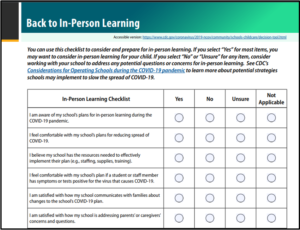
<a href="https://www.cdc.gov/coronavirus/2019-ncov/downloads/community/schools-childcare/back-to-school-decision-checklist.pdf" target="_blank" rel="noopener noreferrer" data-wpel-link="external"><strong>Schools and Childcare Decision Tool</strong></a>

This <strong><a href="https://www.cdc.gov/coronavirus/2019-ncov/downloads/community/schools-childcare/back-to-school-decision-checklist.pdf" target="_blank" rel="noopener noreferrer" data-wpel-link="external">three-page checklist</a></strong> is designed to help you determine which school option, in person or virtual, is best for your child

<a href="https://www.cdc.gov/coronavirus/2019-ncov/downloads/community/schools-childcare/back-to-school-decision-checklist.pdf" target="_blank" rel="noopener noreferrer" data-wpel-link="external"><strong><img src="/wp-content/uploads/sites/1603815/2021/06/BacktoInpersonLearningPicture1-300x230.png" alt="" width="300" height="230" /></strong></a>

<strong>Daily Life Coping – Ways to protect children from getting and spreading COVID-19.</strong>

This <strong>webpage</strong> gives you tips and links to videos with health-related teaching tools on washing hands, wearing masks, and other considerations.

<img class="alignnone size-medium wp-image-46395" src="/wp-content/uploads/sites/1603815/2021/06/Covid19Picture1-300x119.png" alt="" width="300" height="119" />

<strong>Talking with children about Coronavirus</strong> – This page outlines useful strategies for parents and others who communicate with children.


<a href="https://www.cdc.gov/coronavirus/2019-ncov/daily-life-coping/talking-with-children.html" target="_blank" rel="noopener noreferrer" data-wpel-link="external"><img class="alignnone size-medium wp-image-46390" src="/wp-content/uploads/sites/1603815/2021/06/TalktoChildrenPicture1-300x111.png" alt="" width="300" height="111" /></a>

<strong>Show a united front</strong>

In a shared custody situation, you can’t make decisions without the agreement of the co-parent and you must follow your court order. Parents should work together to determine if a short-term custody modification would be in everyone’s best interest.  You should document these modifications, as well as a timeline. We suggest you work with your family lawyer or a mediator to ensure that all parties are heard and protected.

Susan Eisenberg has been practicing family law in Bucks and Montgomery Counties for over three decades.  Her extensive knowledge and experience negotiating custody conflicts have earned Susan a reputation as a compassionate and fair-handed counsel.  Ms. Eisenberg and her staff are ready to listen and guide clients to an outcome that best suits the child’s needs.]]></content>
						        </entry>
	        <entry>
            <author>
									                    <name>On Behalf of Susan Levy Eisenberg, P.C.</name>
				            </author>
            <title type="html"><![CDATA[How to Resolve Co-Parenting Conflicts During the COVID-19 Pandemic]]></title>
            <link rel="alternate" type="text/html" href="https://www.susaneisenberglaw.com/blog/2021/01/how-to-resolve-co-parenting-conflicts-during-the-covid-19-pandemic/" />
            <id>https://www.susaneisenberglaw.com/?p=46371</id>
            <updated>2023-04-06T11:48:10Z</updated>
            <published>2021-01-19T00:00:01Z</published>
					<taxo:topics><![CDATA[-]]></taxo:topics>
            <summary type="html"><![CDATA[  By Susan Levy Eisenberg Co-parenting always has its share of conflicts and challenges, and now with the COVID-19 pandemic, things have become even more complicated and stressful. Keeping up with changing information and emails from school, helping kids with remote and hybrid learning, and keeping them socialized and safe top the list of daily worries and anxieties. It’s natural for…]]></summary>
			                <content type="html" xml:base="https://www.susaneisenberglaw.com/blog/2021/01/how-to-resolve-co-parenting-conflicts-during-the-covid-19-pandemic/"><![CDATA[<img src="/wp-content/uploads/sites/1603815/2021/06/SELawPicture2-300x200.png" alt="" width="300" height="200" />  <img class="" src="/wp-content/uploads/sites/1603815/2021/06/Eisenberg-Susan-1-240x300.jpg" alt="" width="160" height="200" />
<div>By Susan Levy Eisenberg Co-parenting always has its share of conflicts and challenges, and now with the COVID-19 pandemic, things have become even more complicated and stressful. Keeping up with changing information and emails from school, helping kids with remote and hybrid learning, and keeping them socialized and safe top the list of daily worries and anxieties. It’s natural for parents to be concerned with the actions of their divorced spouse. They may feel the other parent is not following the rules to avoid exposure to the virus. Or conversely, one parent may seem overly entrenched with adherence to strict confinement.</div>
<div>
<div style="margin: 20px 0 0 0;"></div>
<strong>What should a divorced parent do?</strong> Take a deep breath, listen, and negotiate. You may think your ex isn’t following CDC protocols, but for you, not following your court order can present additional difficulties in the future. Enormous backlogs exist in the court system due to the pandemic, and our best advice is to try to reach an agreement that is in the best interest of your child or children. Your kids are dealing with a lot right now, and putting them in the middle of a dispute will not make them safer.

</div>
&nbsp;
<div style="margin: 20px 0 0 0;"></div>
<div><strong>Tips for co-parenting during COVID-19</strong></div>
<ol>
 	<li style="list-style-type: none;">
<ol>
 	<li><strong>Be reasonable.</strong> One day, the pandemic will be under control. In the meantime, it is in every parent’s best interest to remain under control as well. Tempers can flare, and accusations can fly, however the courts will not be pleased with parents who ignore court orders or resist compromise. One household may have members in a high-risk group, or they may be an essential worker with a great deal of exposure to others. During this crisis, it may be necessary to make modifications to a parenting schedule.</li>
</ol>
</li>
</ol>
<div style="margin: 20px 0 0 0;"></div>
<ol>
 	<li><strong>Be flexible.</strong> If one parent is in a high-risk occupation where exposure to the virus is increased, it may make sense for the kids to stay with the other parent until the pandemic surge settles or vaccinations become available. You can also limit exposure by reducing the number of times the children go back and forth between households throughout the week. It may make sense for one parent to have custody during the week and the other on weekends.</li>
</ol>
<div style="margin: 20px 0 0 0;">

Note that you should never unilaterally change your court orders even if you feel the other party is wrong or is unwilling to compromise.
<ol start="3">
 	<li><strong>Be honest.</strong> COVID has created a sense of fear and uncertainty. As a parent you should do your best to maintain open, honest conversations with your children and your ex-spouse. You may be living apart, but you must act as a team to navigate these difficult times.</li>
</ol>
For instance, one parent may be better positioned to facilitate online learning, and it would be best for the children to remain in place until in-person learning resumes. And if a family member, child, or parent shows signs of illness, this information must be shared immediately so a care plan and precautions can be put in place.
<ol start="4">
 	<li><strong>Be prepared.</strong> Crises can happen whether we like it or not. Be prepared to have contingency plans that you and your ex have agreed to in advance. In the short term, one parent may need to forgo or modify custody. However, they can make up this time once the crisis has passed.</li>
</ol>
If a positive case does occur in one of the households, be prepared to modify schedules and put plans in place to keep others safe. Help reinforce your child’s relationship with the absent parent by providing other outlets to connect. This contact could be through Skype or Zoom visits, bedtime story reading via phone or virtual movie nights.

<strong>When all else fails</strong> If you have tried to work through co-parenting challenges with your ex-spouse or partner and you cannot come to agreement, there are alternatives to court. Despite using tools like Bluejeans and Zoom to facilitate court proceedings virtually, remember that the judicial system is dealing with an huge backlog in cases, and they discourage divorced couples from escalating custody issues. A better alternative is to seek the advice and guidance of an experienced family law attorney. They can help you draft a temporary custody agreement or modify a parenting plan to keep the matter out of court. Representation on both sides can work together to develop a plan that addresses critical issues like child safety, schooling, and extra-curricular activities – a compromise on which both parents can agree. Parents must provide consistency and continuity during these difficult times. How you act today will give your child confidence, knowing you will always do what is best for them now and in the future.

If you need help resolving co-parenting issues, Susan Levy Eisenberg, Attorney at Law, is here to help.  With over 30 years of compassionate family law experience in Bucks and Montgomery Counties, Susan will help your work with your ex-spouse or partner and their legal representation to develop an agreement that best suits the child’s needs.

</div>]]></content>
						        </entry>
	</feed>